Stripe's documentation and API design are not accidents — they are the result of treating developer experience as a product decision, not an afterthought
Most developer tooling is built by engineers solving their own problem. Stripe was built by engineers obsessing over someone else's problem.
The reason great developer tooling is rare is not talent. Every well-funded startup has talented engineers. It is priority. DX loses to features almost every time.
Stripe's real innovation was not payments. It was the idea that how software feels to integrate is as important as what it does.
The uncomfortable question it raises: how much bad software exists not because it could not be better but because nobody made the quality of the experience a non-negotiable.
I want to tell you about the first time I integrated Stripe.
I had integrated payment APIs before. I knew what to expect. Long PDFs pretending to be documentation. Authentication flows that required three support tickets to understand. Sandbox environments that behaved differently from production in ways that only revealed themselves after you deployed. The general experience of feeling like the API was built for a specific person and you were not that person and the documentation had given up trying to explain it to you.
Stripe was different in a way I could not immediately explain.
Within twenty minutes I had a working checkout. Not a toy. A real one. I had not read a forum post. I had not opened a second tab. I had not emailed support. I had read the documentation, followed it, and the thing worked exactly the way the documentation said it would.
I remember sitting back and thinking: why does this not happen more often.
That question has stayed with me. This post is my attempt to answer it.
The Documentation Is Not a Feature. It Is an Argument.
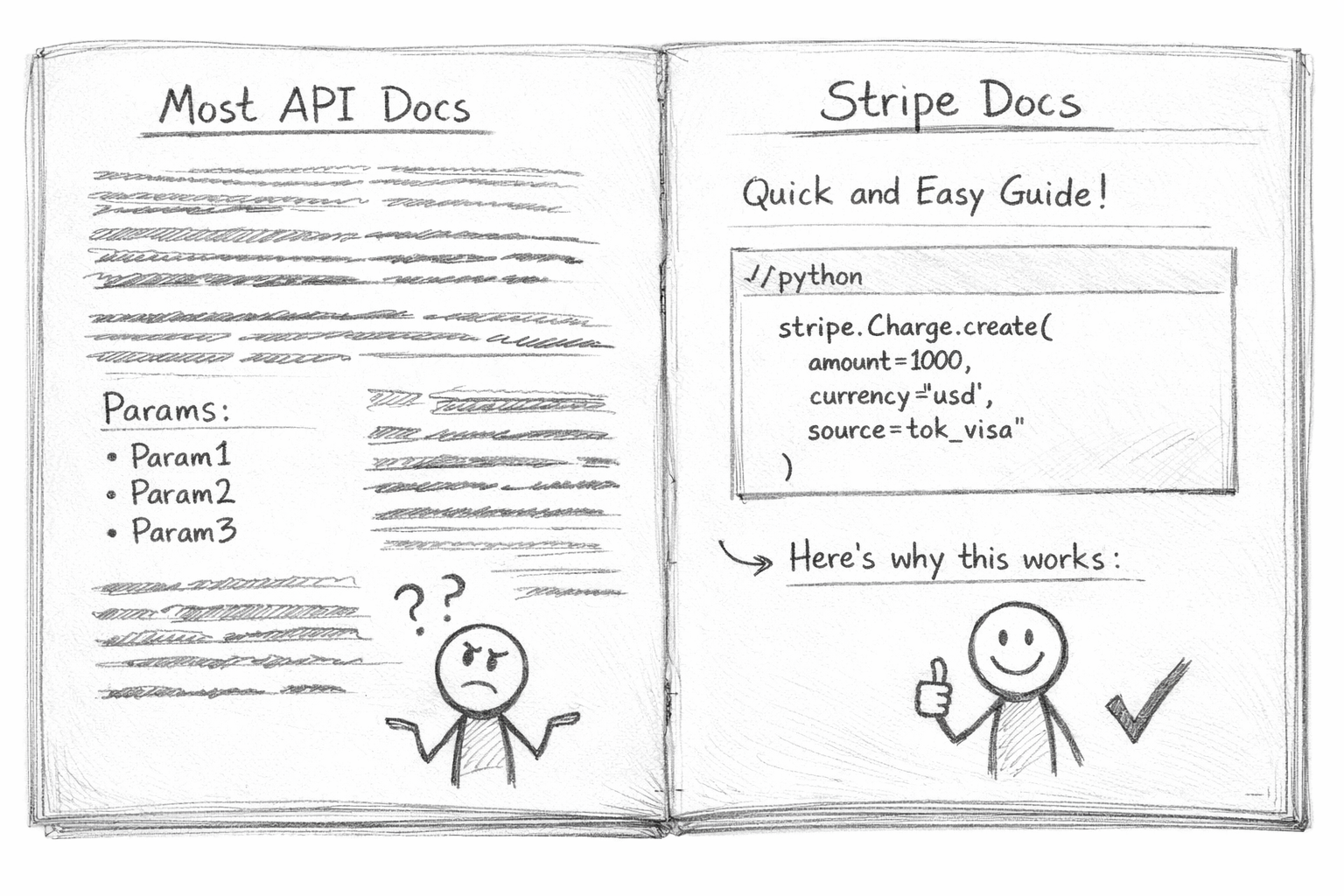
Most developer documentation is written to cover the company legally and technically. It lists what exists. It describes parameters. It tells you the shape of the thing without telling you how to think about the thing.
Stripe's documentation is written to change how you think.
Open the Stripe docs and the first thing you notice is that it assumes you are intelligent but not omniscient. It does not condescend. It does not assume you already know everything either. It gives you context before it gives you instructions. It tells you why before it tells you how. And it gives you a working example immediately, before you have committed to anything, so you can see what the end state looks like before you decide if the path there makes sense.
This sounds simple. Almost every company that has tried to replicate it has failed. Because writing documentation that actually teaches rather than just describes requires the writer to have genuinely understood what the reader does not yet know and to care enough about that gap to close it. That is harder than it sounds and it requires time that most engineering teams do not protect for documentation.
Stripe protected it. You can feel the difference.
Two side-by-side doc pages: "Most API Docs" with dense text and a confused figure vs "Stripe Docs" with a clear example and a checkmark.
The API Design Is a Point of View
Here is what most people mean when they say an API is well designed. It is consistent. The naming makes sense. The endpoints follow a pattern. You can guess what something is called before you look it up.
That is table stakes. Stripe did something harder.
Stripe's API has a point of view about how payments should work conceptually. The objects it exposes — Customers, PaymentIntents, Sources, Subscriptions — are not just database tables with HTTP endpoints in front of them. They are a model of how payment flows actually behave in the real world. The abstractions are load-bearing. They reflect decisions about what matters and what does not that someone thought carefully about before writing a single endpoint.
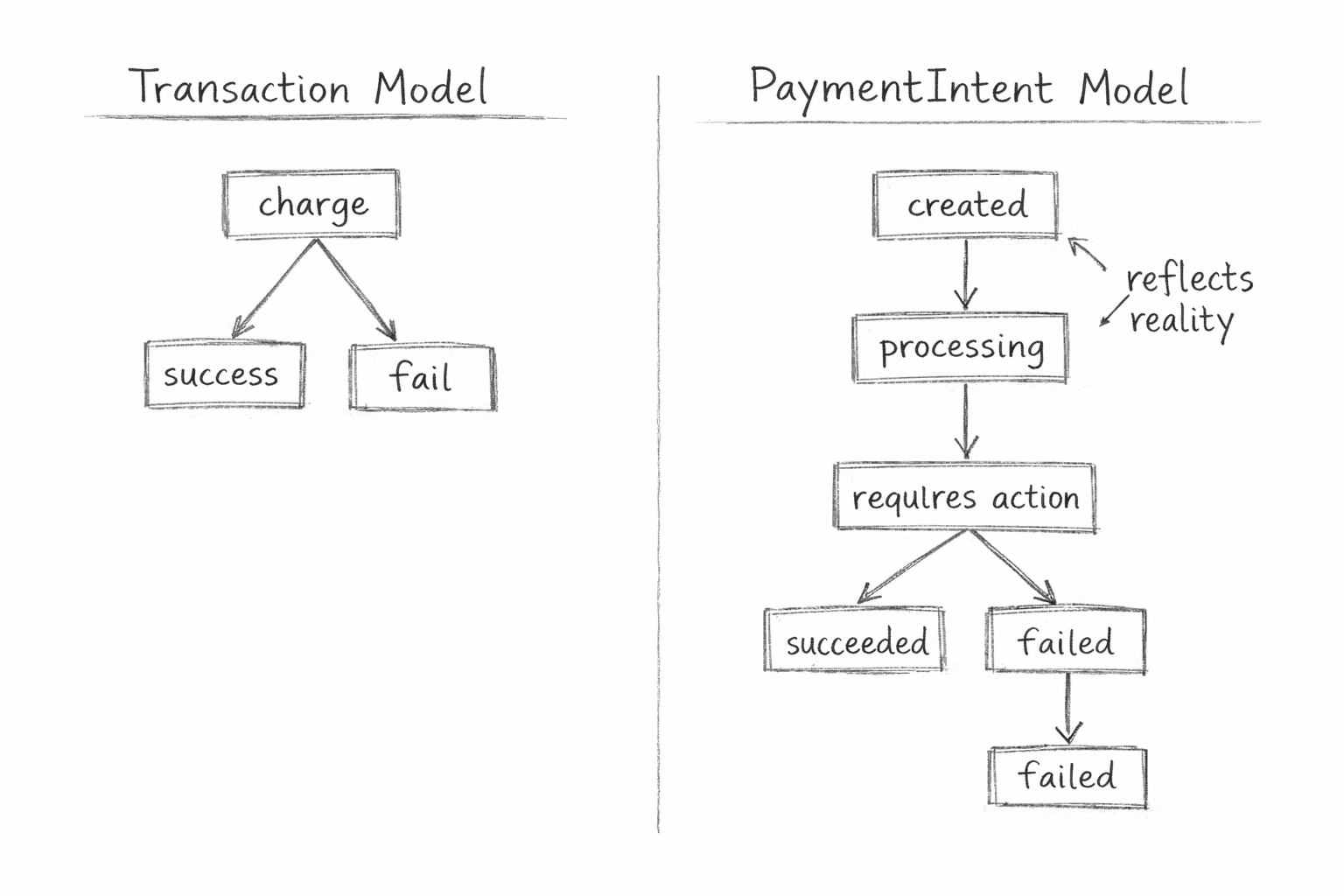
The PaymentIntent object is a good example. A payment is not an event. It is a process. It starts, it can fail, it can require additional authentication, it can be cancelled, it can be disputed later. Modelling it as an object with a lifecycle rather than a transaction you either complete or do not changes how you build things on top of it. It forces the right mental model on you from the first integration.
Most payment APIs give you a function that takes a card number and returns success or failure. Stripe gave you a way to think about what a payment actually is. That is the difference between a tool and a design.
Two payment flows: "Transaction Model" with a single charge to success/fail vs "PaymentIntent Model" showing a full lifecycle — created, processing, requires action, succeeded, failed.
They Treated Developer Experience as the Product
This is the part that most companies get wrong in a specific and consistent way.
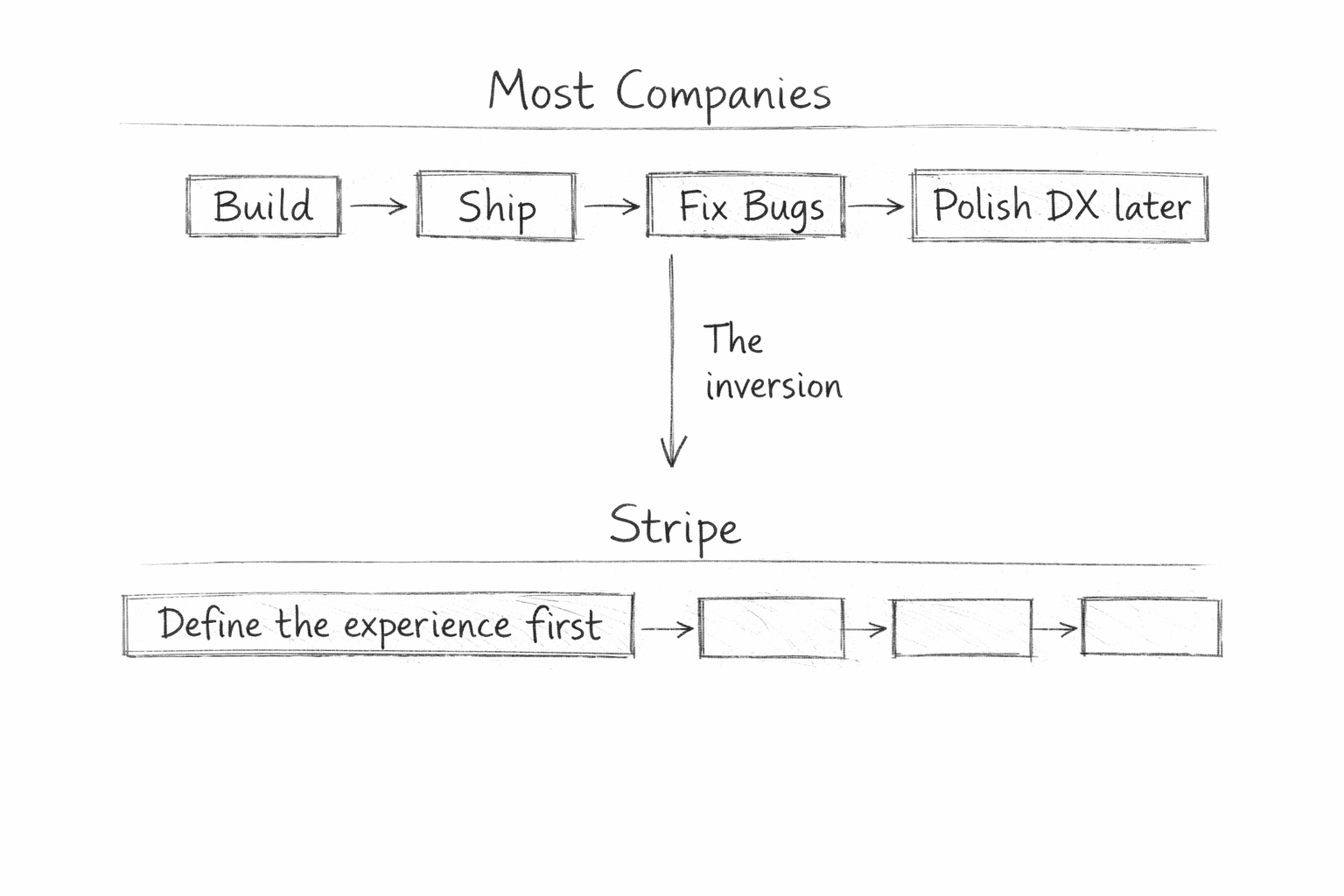
At most companies, developer experience is something you improve after the product is working. You build the thing, you ship the thing, and then at some point if you have time you make the documentation better and smooth out the rough edges in the API. DX is a polish layer applied after the substance is done.
At Stripe, developer experience was never the polish. It was the product.
The two Collison brothers started Stripe because integrating payments was genuinely painful and they believed the integration experience itself was the problem worth solving. Not just the technology underneath. The experience of using the technology. The seven lines of code that became famous as Stripe's founding pitch were not a demo. They were a product specification. This is what we are building toward. An integration that takes seven lines and works.
That starting point — defining the experience you want someone to have and then building the technology to produce that experience — is the inversion most companies never make. They build the technology and then hope the experience turns out acceptable.
It is a different orientation entirely. And you can feel it in everything Stripe ships.
Two timelines: "Most Companies" builds first, documents later. "Stripe" defines the developer experience first and builds toward it.
So Why Can Nobody Replicate It
This is the uncomfortable part.
Every major company that has tried to build developer tools in the last decade has had money. Most of them had engineers as smart as anyone at Stripe. Some of them had better underlying technology. Several of them failed anyway to produce anything that felt like Stripe feels.
The reason is not talent and it is not resources. It is priority under pressure.
Building software that actually feels good to use is slower than building software that technically works. Writing documentation that teaches rather than just describes takes time that could go to new features. Designing APIs that model the domain correctly requires throwing away work that already technically functions but reflects the wrong mental model. Maintaining that standard as the company scales means saying no to a hundred shortcuts that would each individually seem reasonable.
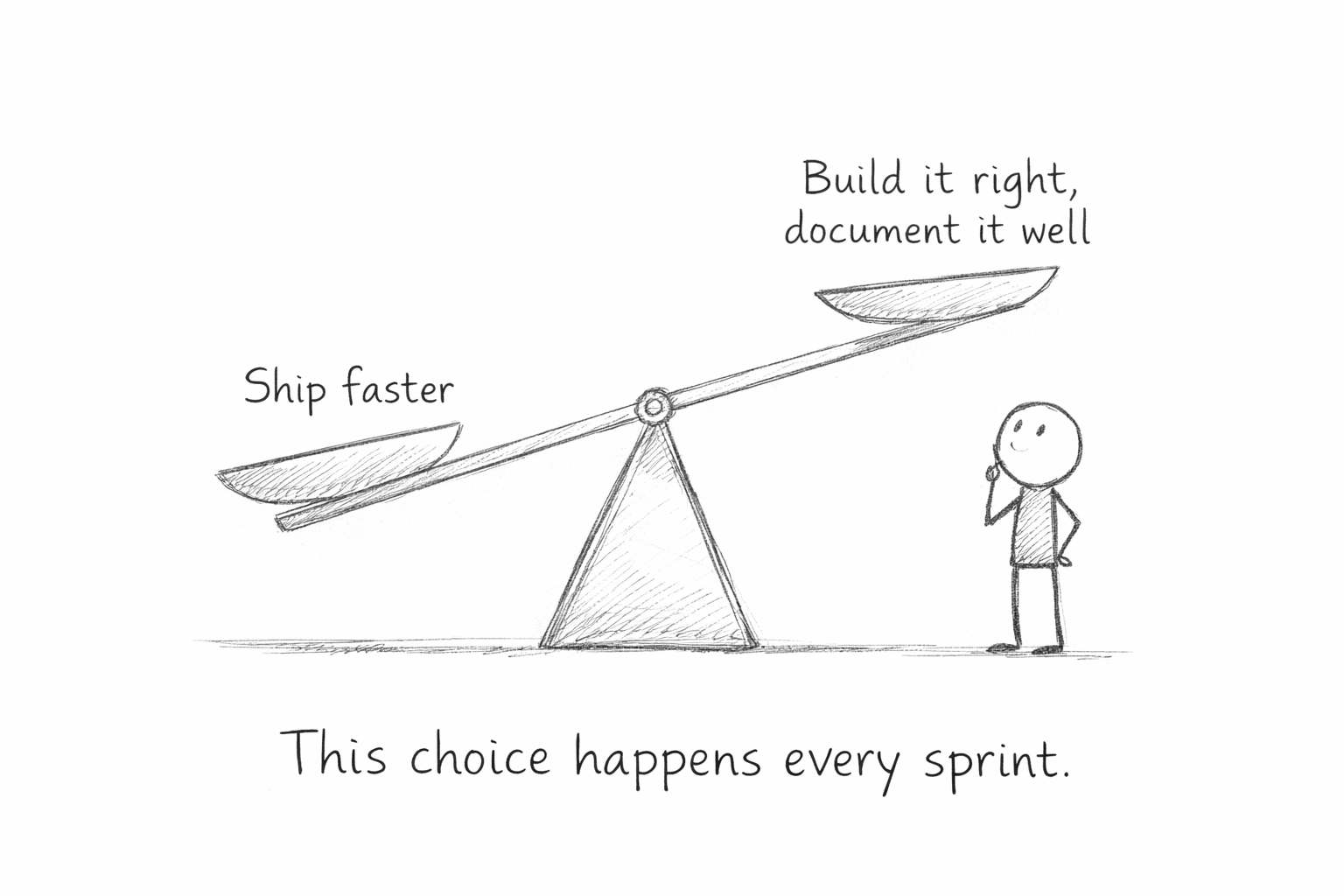
In a startup under growth pressure, every one of those investments loses to the thing that ships faster. The documentation is good enough. The API is consistent enough. The developer experience is acceptable enough. Progress is progress.
Stripe was not immune to this pressure. But somewhere early on they made the quality of the integration experience a non-negotiable rather than a goal. That distinction matters enormously. Goals get traded away when things get hard. Non-negotiables do not.
Most companies never make that call. Or they make it early and unmake it when the first deadline hits.
A set of scales: "Ship faster" weighs heavily on one side, "Build it right" floats up on the other. A note below reads "This choice happens every sprint."
What It Actually Cost Them
I want to be clear about something. Stripe is not a charity. They charge for this quality and they charge well. The pricing has frustrated enough developers and finance teams that there is an entire category of Stripe alternatives that exists almost purely on the thesis that Stripe is too expensive and their cut is too high.
That is a fair criticism. Pricing is a real thing.
But the pricing conversation is separate from the quality conversation and they often get conflated. Stripe is expensive and Stripe is genuinely excellent and both of those things are true. The fact that the experience is worth paying for does not mean every team can afford to pay for it. The fact that the alternative is cheaper does not mean the experience is equivalent.
What Stripe proved is that the ceiling for software quality is much higher than most companies build to. Not because they do not have the engineers. Because they do not treat the ceiling as worth reaching.
That is the real lesson. Not that Stripe is perfect. That most software accepts a quality level that was never inevitable. It was just easier.
The Question It Leaves You With
I have integrated a lot of APIs in my career. I have read a lot of documentation. I have worked around a lot of design decisions that made the wrong thing easy and the right thing hard.
Stripe is the clearest example I know of what happens when a company decides that the experience of using their product is as important as the product itself. Not as a marketing position. As an engineering constraint.
The question it leaves me with is an uncomfortable one.
How much of the bad software we accept as normal is actually inevitable. And how much of it is just the result of never making quality a non-negotiable. Of always finding a reason why good enough is close enough to great.
Stripe did not invent anything technically that other payment companies did not have access to. They made a different set of decisions about what mattered.
That is either encouraging or damning depending on which software you are responsible for.