
Stripe Is What Software Is Supposed to Feel Like

Sep 10, 20267 min read
iPhone 18: The Complete Feature Guide (And Who Should Actually Buy It)
Apple's iPhone 18 Pro arrives September 2026 with the A20 chip, smaller Dynamic Island, and a foldab...
Devesh Korde
April 15, 2026
Apple launched three products at its March event that most people are still talking about. The M5 MacBook Air. The M5 Pro MacBook Pro. The new Studio Display.
The one that will matter most in five years got the least coverage.
The MacBook Neo. $599. A18 Pro chip. Full macOS. Comes in Indigo, Blush, and Citrus. Looks like an iPad had a laptop for a baby.
On the surface it looks like Apple finally decided to compete with Chromebooks. Which is true, and is a perfectly fine story. Student market. Education. First-time Mac buyers. Switchers from Windows who cannot stomach $999 for the Air.
But Bloomberg's Mark Gurman buried the more interesting line in his coverage. Apple designed the Neo to target, in his words, "would-be iPad buyers who might prefer a traditional laptop experience instead."
Read that sentence again.
Apple built a laptop to intercept customers who were about to buy an iPad. And priced it at exactly the same entry point as the iPad Air. At $599.
That is not a coincidence. That is a product decision. And it has been a long time coming.
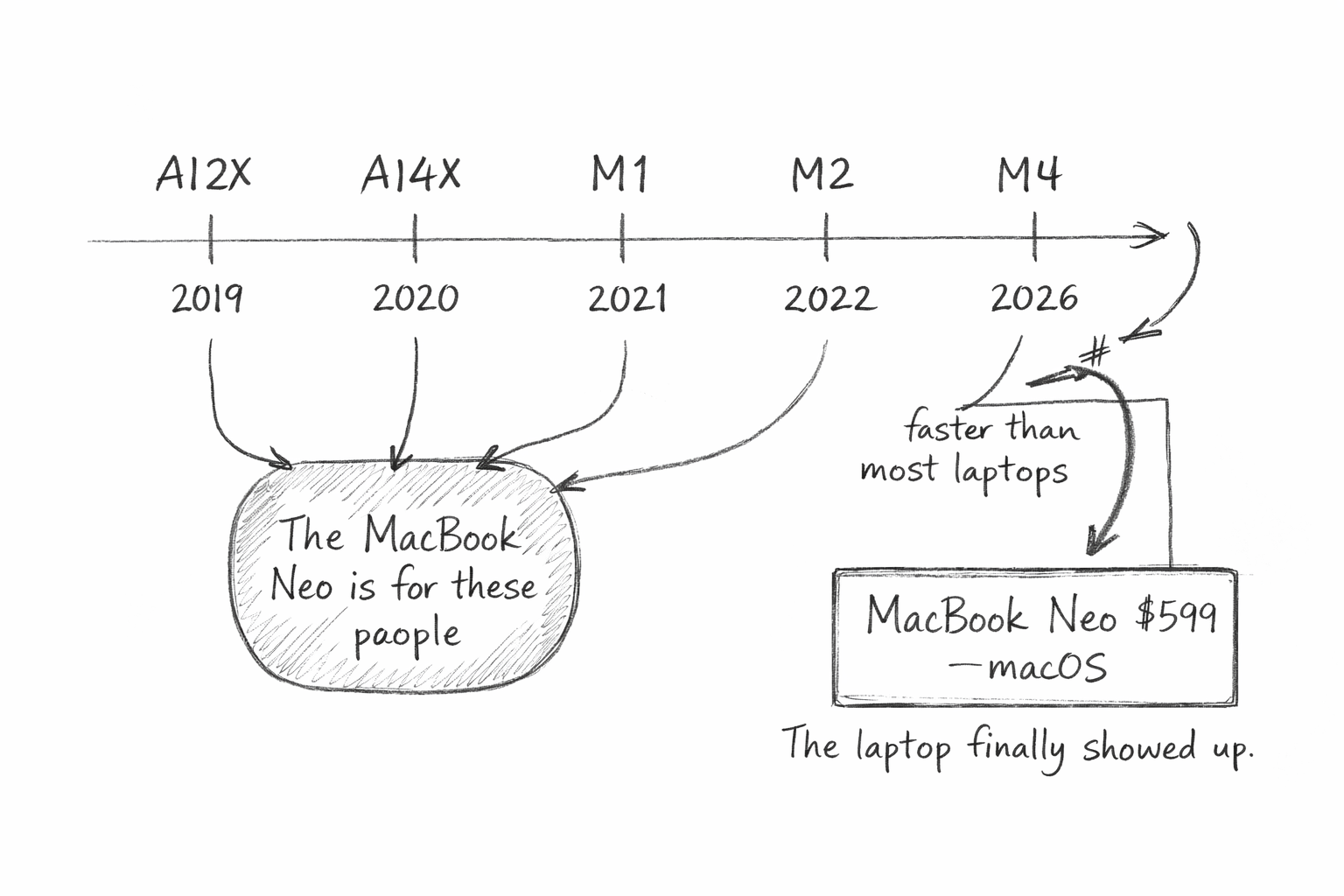
The iPad Pro is a remarkable piece of hardware. The M4 model that launched last year is faster than most laptops. The display is extraordinary. The build quality is everything you expect from Apple at the top of its game.
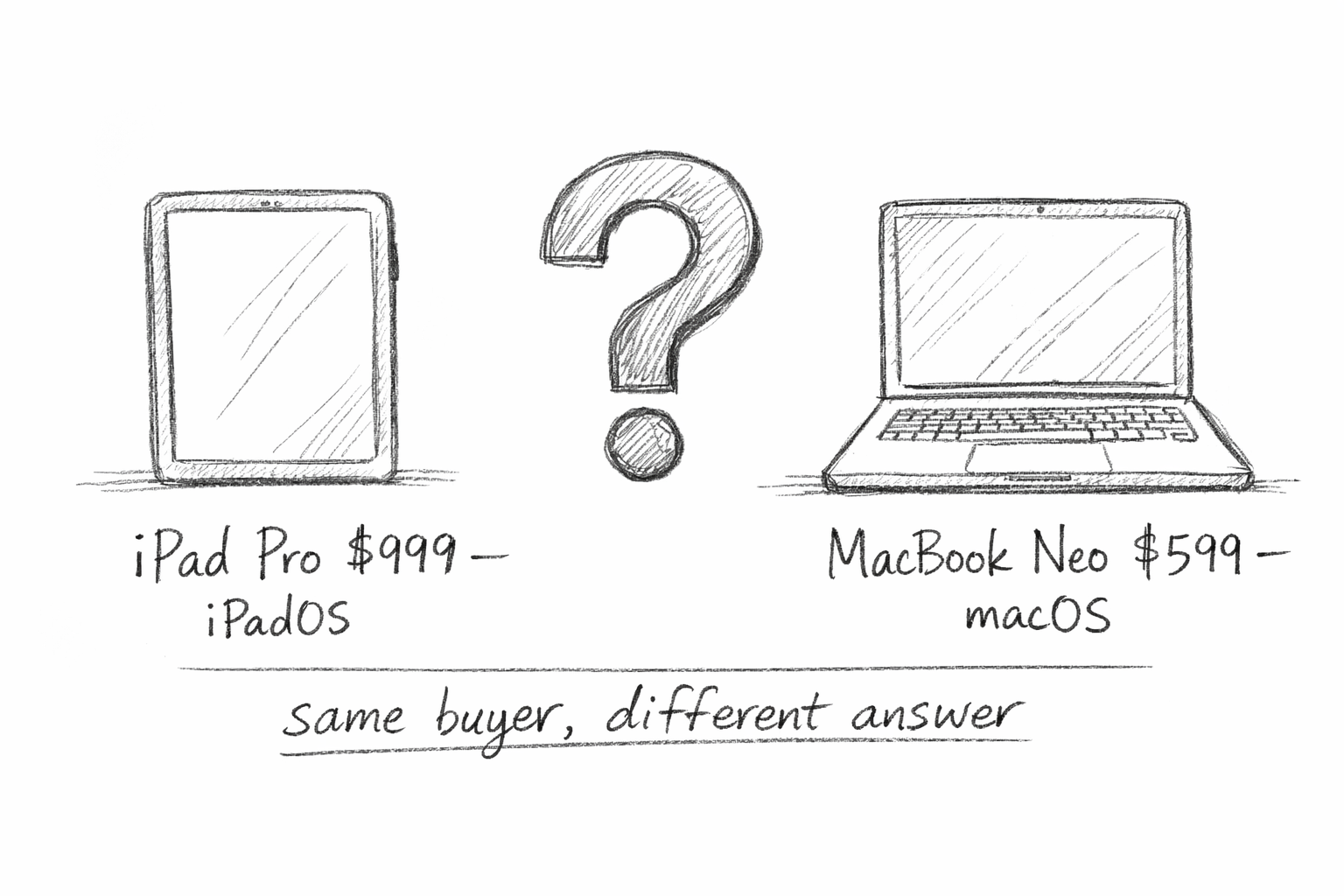
And it starts at $999 for the 11-inch. Without a keyboard. Without a trackpad. Running iPadOS.
That last part is the one nobody at Apple will talk about honestly. iPadOS is not macOS. It never has been. You cannot run Xcode on it. You cannot run a proper terminal. Multitasking works, technically, but it works the way a Swiss army knife works when you really needed a kitchen knife. Functional. Not the same thing.
Every year since the iPad Pro got desktop-class chips, developers and power users have asked the same question. Why is this $1000 plus device running a mobile operating system? The hardware stopped being a tablet years ago. The software never caught up.
Apple's answer, every year, has been some version of: the iPad is a different kind of computer and that is a feature, not a limitation. A fresh canvas. Multitouch first. Different workflows for different people.
That answer is wearing thin. And the MacBook Neo is what happens when Apple quietly stops making it.
Let me be specific about what the Neo is, because the spec sheet matters here.
The MacBook Neo runs on the A18 Pro chip — the same processor from the iPhone 16 Pro. It features a 13-inch Liquid Retina display with no notch, uniform iPad-style bezels, and comes in Silver, Indigo, Blush, and Citrus. In practice, it performs similarly to an M1 MacBook Air for everyday tasks — web browsing, productivity apps, media consumption — which is more than fast enough for typical workloads.
What it does not have is also worth naming. It supports Wi-Fi 6E rather than Wi-Fi 7, and has two USB-C ports — one USB 3 and one USB 2 — with no Thunderbolt support. The display is a standard LCD, not mini-LED. You can connect one external display, not two.
These are real compromises. For the audience Apple is targeting, almost none of them matter.
The person who was considering an iPad Air with a Magic Keyboard — which runs around $950 once you add the keyboard — is now looking at a MacBook Neo running full macOS for $599. That person gets a trackpad. A proper keyboard included in the price. Every Mac application. A file system that behaves like a file system. Terminal. Xcode. The software ecosystem that the iPad Pro has been gesturing at for four years without actually delivering.
Internally at Apple, the Neo is described as "incredible value," with the company believing it could even compel iPhone users without computers to buy their first Mac.
That is the device. The question is what it means for everything above it in the lineup.
The iPad Pro has always had two kinds of customers.
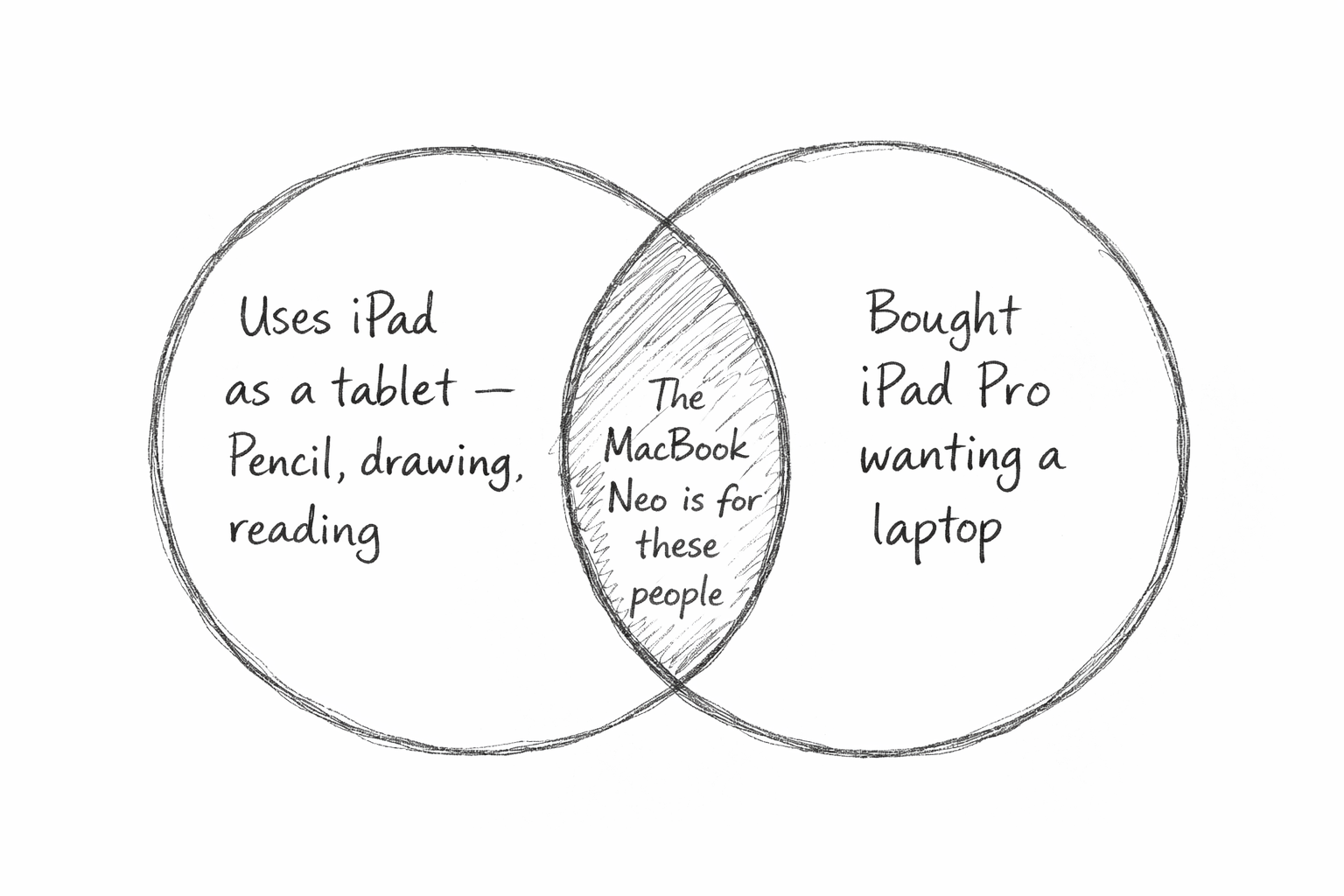
The first group genuinely uses it as a tablet. Artists. Note-takers. People who read, annotate, sketch, and consume. For them the iPad Pro is the right tool. The Apple Pencil integration is unmatched. The display is stunning. The form factor is the point.
The second group bought it because they wanted a powerful portable computer and the MacBook felt like too much. Students. Casual professionals. People who mostly browse, write, video call, and edit the occasional photo. They bought the iPad Pro because the chip benchmarks were impressive and the price was lower than a MacBook Pro.
That second group was always buying the wrong device. They knew it. The keyboard cover that turns the iPad into a laptop-shaped object was the tell. You do not buy a $350 keyboard for a device you want to use as a tablet. You buy it because you wanted a laptop and convinced yourself the iPad was close enough.
The MacBook Neo is Apple finally handing that group the device they actually wanted.
Bloomberg's Gurman noted the Neo targets "would-be iPad buyers who might prefer a traditional laptop experience instead." That sentence, from someone with reliable Apple sources, is as close to an official acknowledgment as Apple will ever give that the iPad Pro was being purchased for the wrong reasons by a meaningful number of people.
Apple has a product line problem it has been managing carefully for years.
If Apple officially says the MacBook Neo is better than an iPad Pro for most use cases at a lower price, it devalues the iPad Pro. Which is a $999 to $1299 product with healthy margins. Which is the centrepiece of the iPad line. Which Tim Cook has called the future of computing more than once in public.
So Apple will not say it. The marketing for the Neo talks about Chromebook switchers. Students. First-time Mac owners. Not iPad Pro buyers. The positioning is deliberate and the omission is deliberate.
But the product does not care about the positioning. A $599 full macOS laptop sitting next to a $999 iPadOS tablet in an Apple Store does not need a press release to make its argument. The customer makes the comparison themselves.
A comment from MacRumors' own coverage put it plainly: "It's ironic that Apple finally has the technology to make super fast and efficient chips perfect for impossibly small, thin and light MacBooks, but the iPad Pro is probably preventing them from doing so in fear of people ditching the iPad for it."
That fear is real. And the MacBook Neo is Apple deciding, quietly, that the fear costs more than the cannibalisation.
The iPad Pro is not going away. The artists and tablet-native users are not going anywhere. The Apple Pencil integration has no equivalent on a laptop. For the use cases the iPad Pro actually excels at, nothing changes.
What changes is the justification for buying it as a productivity computer.
The argument for the iPad Pro as a laptop replacement was always thin and got thinner every year. The Neo makes it indefensible for most people at most price points. If you are buying a device to write, browse, video call, and do light creative work, the Neo gives you macOS for $400 less than the entry iPad Pro and $200 less than the iPad Air.
The iPad Pro now needs to compete on what it actually is. A tablet. A remarkably capable one. The best one Apple has ever made. But a tablet.
That is not a demotion. It is a clarification. And it is one Apple has been avoiding making for five years because the iPad Pro's identity as a laptop replacement was driving a lot of its sales.
The MacBook Neo just made that identity harder to sustain.
Apple has spent years building the narrative that iPad and Mac are complementary. Different tools for different jobs. Not competing. Not cannibalising.
The MacBook Neo at $599 is the first product Apple has shipped that makes that narrative hard to maintain with a straight face.
Not because the iPad is bad. The iPad Pro is extraordinary at what it is. But at $599 for full macOS, the Neo forces the question that Apple has been careful never to answer directly.
If you are buying an iPad Pro to use it like a laptop, why are you buying an iPad Pro?
The answer used to be that there was nothing else. Now there is.
At $599. In Citrus.