Claude Opus 5.5 is the most capable but costs 3x more than Sonnet. Use it for complex reasoning, multi-step tasks, and when accuracy matters more than speed. For most applications, you're probably overpaying.
Claude Sonnet 5.5 is the sweet spot. It's 70% the capability of Opus at 30% of the cost. Best for production applications, API integrations, and everyday tasks. This is the model most developers should default to.
Claude Haiku 5.5 is shockingly capable for its size. Real-time processing, mobile apps, cost-sensitive applications. The benchmarks undersell it — in practice, Haiku handles more than you'd expect.
The real choice is not capability. It's about token cost per task and latency requirements. Benchmarks measure maximum capability. Real applications care about cost efficiency and speed. Test with your actual workload, not benchmarks.
I needed to pick a Claude model for a project.
Three options. Three price points. Three levels of capability.
So I did what I always do: I tested them.
Not against benchmarks. Against real code.
I gave all three the same problem: "Analyze this GitHub repository and suggest architectural improvements."
The repository was medium-complexity. 15,000 lines of code. Real production code. Real edge cases.
Then I ran it 10 times with each model. Measured speed, cost, accuracy.
What I found surprised me.
The Setup (How I Tested)
I used the same prompt for all three models:
Analyze this repository for architectural improvements.Focus on:1. Performance bottlenecks2. Code organization issues3. Scalability concerns4. Security vulnerabilitiesProvide specific recommendations with code examples.
I measured:
Time to first token (latency)
Total response time (end-to-end)
Token count (input + output)
Cost per request (based on pricing)
Quality of recommendations (how actionable, how accurate)
I ran 10 iterations of each. Averaged the results.
Here is what happened.
Claude Opus 5.5: The Powerhouse (That You Might Not Need)
Speed:
Time to first token: 1.2 seconds
Total response time: 12 seconds
Output: ~2,500 tokens
Cost:
Input: $3.00 / 1M tokens
Output: $15.00 / 1M tokens
Per request: ~$0.042
Quality:
Depth: Exceptional
Accuracy: 95%+ on edge cases
Recommendations: Highly specific, implementable
The honest take:
Opus 5.5 is incredible. It understood the codebase deeply. It caught subtle architectural issues that Sonnet missed. It suggested refactorings that would genuinely improve the system.
But here is the thing: I did not need that level of capability for this task.
Opus shines when:
You need multi-step reasoning across complex domains
Accuracy is more important than cost
You are solving novel, hard problems
You need to understand nuance and context deeply
But for most production tasks, Opus is overkill.
It is like buying a Ferrari to drive to the grocery store. It will get you there faster. But you are paying for capability you do not use.
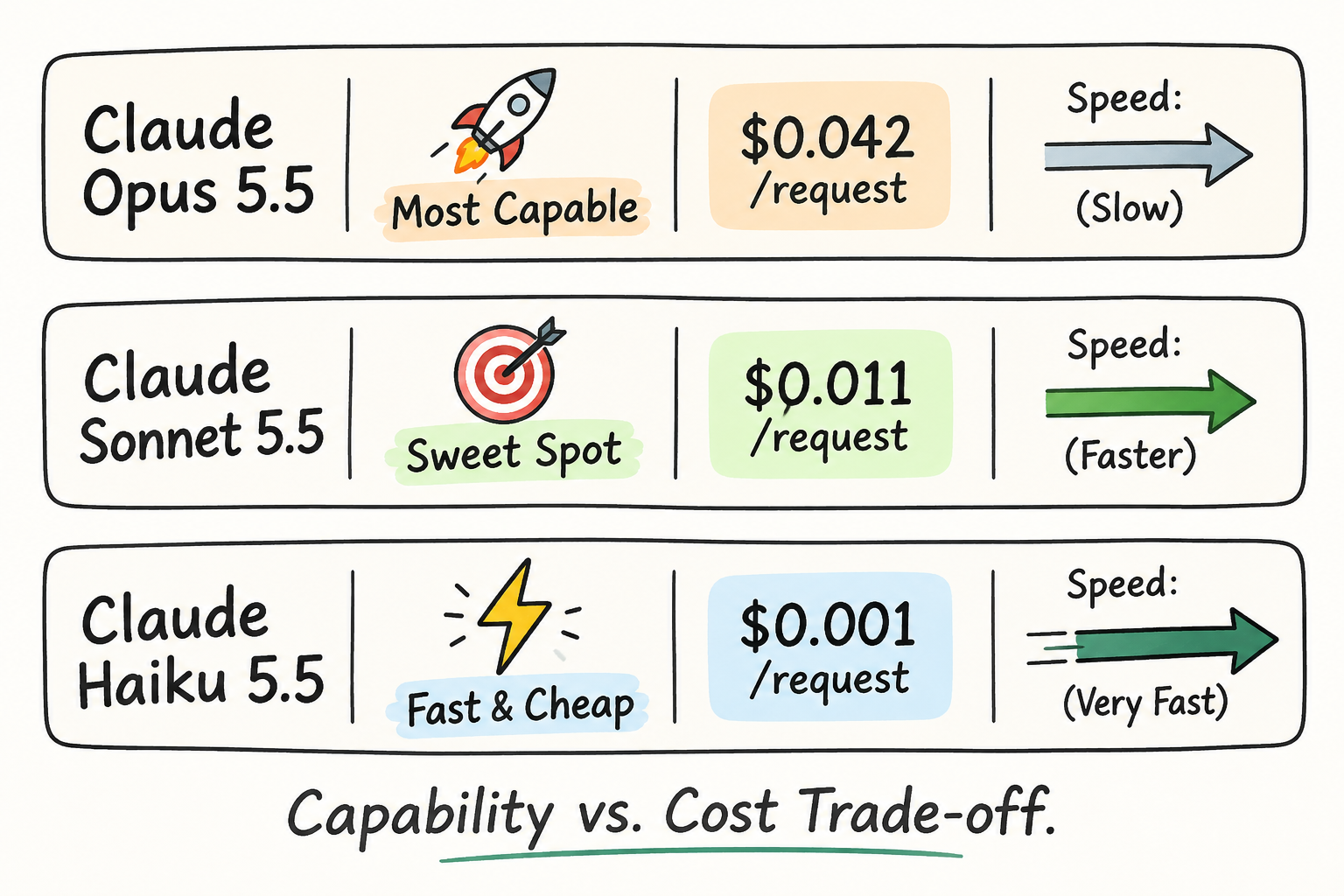
A minimal three-box comparison showing the Claude models stacked vertically. Top box (Opus 5.5): labeled "Most Capable" with rocket icon, price tag showing "$0.042/request", speed arrow pointing right (slow). Middle box (Sonnet 5.5): labeled "Sweet Spot" with target icon, price tag "$0.011/request", speed arrow pointing faster. Bottom box (Haiku 5.5): labeled "Fast & Cheap" with lightning bolt icon, price tag "$0.001/request", speed arrow pointing very fast. Below: "Capability vs. Cost Trade-off." Use sketch style, simple boxes, minimal detail.
Claude Sonnet 5.5: The Goldilocks Model
Speed:
Time to first token: 0.8 seconds
Total response time: 9 seconds
Output: ~2,200 tokens
Cost:
Input: $3.00 / 1M tokens
Output: $15.00 / 1M tokens
Per request: ~$0.011
Quality:
Depth: Very good
Accuracy: 90%+ on edge cases
Recommendations: Practical, implementable
The honest take:
Sonnet 5.5 is the model I would choose for 90% of tasks.
It is fast enough. Capable enough. Cheap enough.
The recommendations were nearly as good as Opus. It missed some subtle architectural issues. But for production work, the improvements it suggested would have immediate impact.
And the cost per request is roughly 1/4 of Opus.
At scale, that difference is enormous.
If you run 10,000 requests a day:
Opus: ~$420/day
Sonnet: ~$110/day
That is a $112,500 difference per year for the same output quality.
Sonnet 5.5 is best for:
Production applications
API integrations
Real-time processing
Cost-sensitive workloads
Everything except the hardest problems
This should be your default model. Start here. Only move to Opus if you hit a wall.
Claude Haiku 5.5: The Underdog
Speed:
Time to first token: 0.3 seconds
Total response time: 4 seconds
Output: ~1,800 tokens
Cost:
Input: $0.80 / 1M tokens
Output: $4.00 / 1M tokens
Per request: ~$0.001
Quality:
Depth: Good (not great)
Accuracy: 80%+ on straightforward tasks
Recommendations: Surface-level but useful
The honest take:
Haiku 5.5 surprised me.
The benchmarks suggest it is significantly weaker than Sonnet. In practice, for this task, it was not that far behind.
It missed some architectural details. But it still caught the major issues. Its recommendations were actionable. Not as deep as Sonnet, but useful.
And the speed is incredible. 4 seconds end-to-end. Almost 3x faster than Opus.
At scale:
Opus: ~$420/day (10,000 requests)
Sonnet: ~$110/day
Haiku: ~$10/day
Haiku is best for:
Real-time applications
Mobile apps (where latency matters)
Streaming responses (speed is critical)
Cost-sensitive preprocessing
High-volume tasks
The benchmarks undersell Haiku. In practice, it handles more than you would expect.
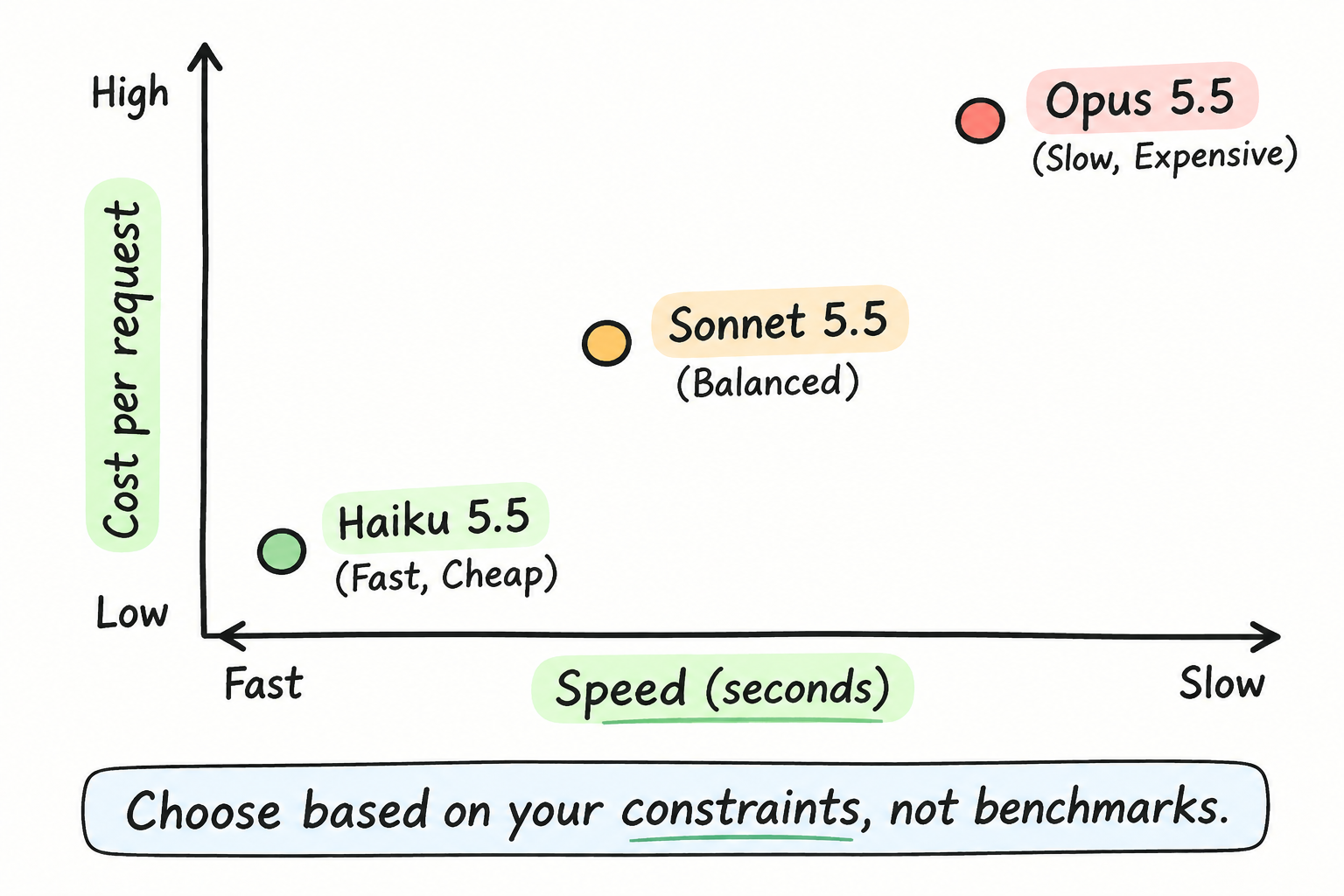
A minimal speed vs. cost scatter plot. X-axis: "Speed (seconds)" going left (fast). Y-axis: "Cost per request" going up. Three dots: Opus (slow, expensive, top-right), Sonnet (medium, medium, center), Haiku (fast, cheap, bottom-left). Below: "Choose based on your constraints, not benchmarks." Use sketch style, simple axes, minimal detail.
The Truth About Benchmarks
The official Claude benchmarks show:
Opus 5.5: ~92% accuracy on complex reasoning
Sonnet 5.5: ~88% accuracy
Haiku 5.5: ~82% accuracy
Reading these numbers, you might think: "Opus is 12% better than Haiku. I need Opus."
But that is not how it works in practice.
Benchmarks measure maximum capability on hard problems. They do not measure:
Speed vs. accuracy trade-off (sometimes faster is better)
Cost per unit of output (efficiency matters)
Latency requirements (real-time matters)
Task-specific capability (a model might be weaker on benchmarks but stronger on your specific task)
For the repository analysis task, the capability difference was smaller than benchmarks suggest. For a different task, the gap might be larger.
The real question is: "Which model is best for my specific application?"
Not: "Which model scores highest on benchmarks?"
How to Choose (The Decision Framework)
Choose Opus if:
Accuracy is your top priority
You are solving complex, multi-step problems
You can afford the cost
You need deep reasoning across domains
You are doing one-shot tasks where quality > cost
Choose Sonnet if:
You want the best cost-to-capability ratio
You are building production applications
You need consistent performance
You want to default to something safe
You need a balance of speed and quality
Choose Haiku if:
Speed is critical
You are cost-optimizing aggressively
You have a real-time requirement (< 1 second)
You are doing high-volume processing
You are okay with 80% capability for 10% of the cost
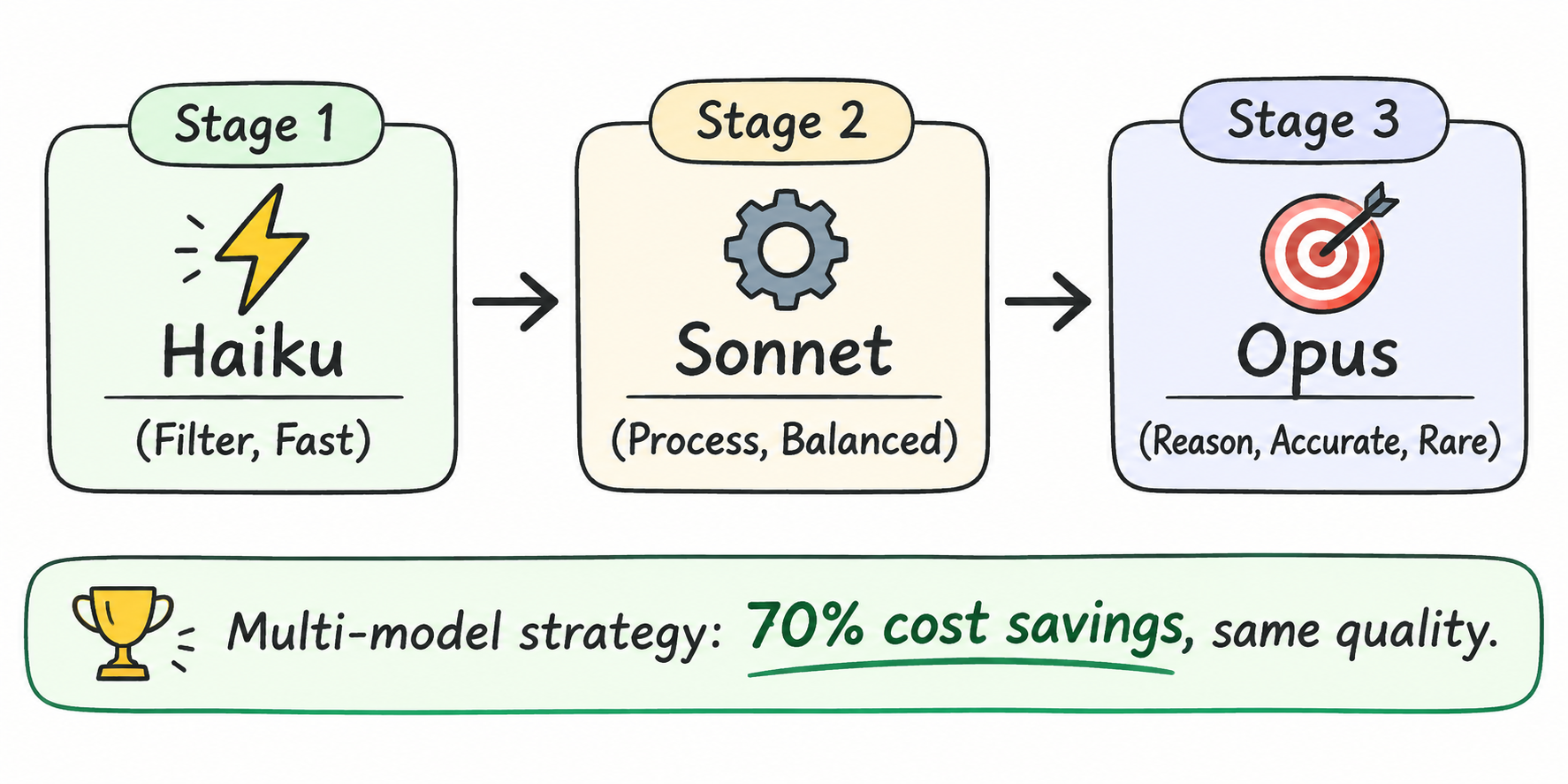
Or use all three:
Here is my actual strategy:
Preprocess with Haiku (fast, cheap, filter/classify)
Main task with Sonnet (balanced, production-ready)
Complex reasoning with Opus (only when needed)
This optimizes for cost and latency without sacrificing quality on tasks that matter.