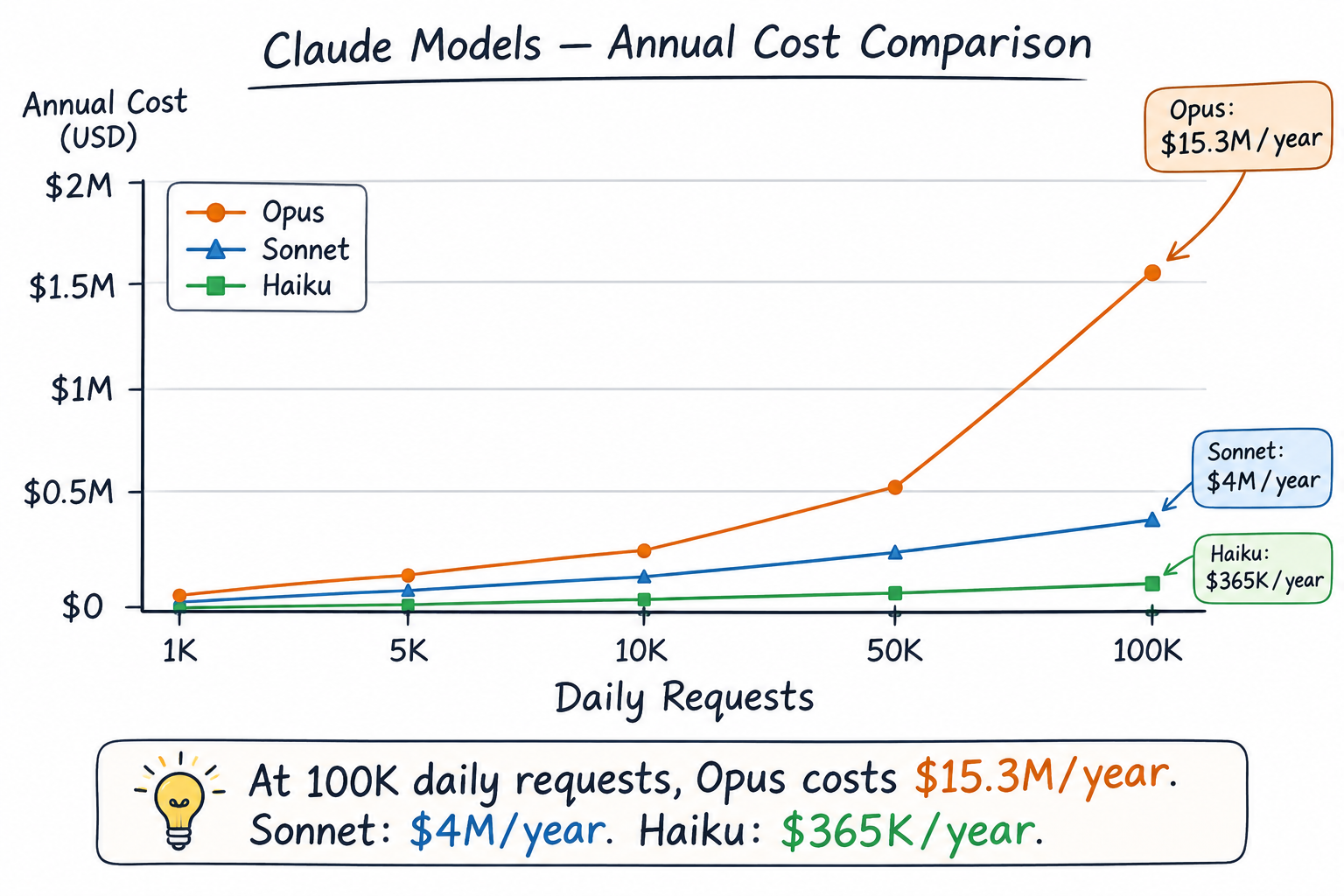
Opus costs 3.8x more than Sonnet per request ($0.042 vs $0.011). At scale, this is $112,500/year more for 10K daily requests. Most teams never need that extra capability and are just burning money.
Opus shines for true multi-step reasoning: research synthesis, complex code refactoring, novel problem-solving, deep domain analysis. For everything else — classification, extraction, formatting, templating — Sonnet is sufficient.
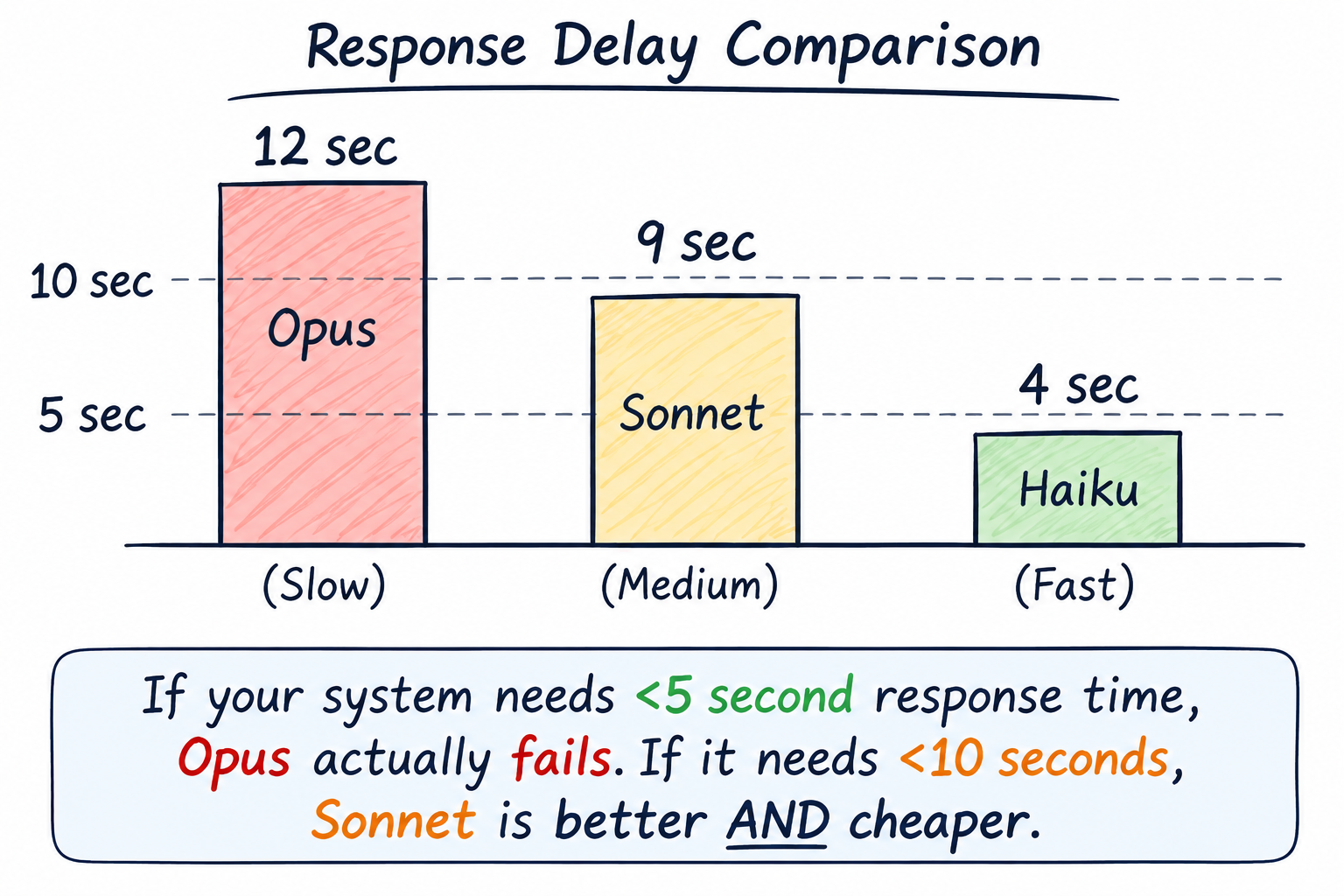
The hidden Opus tax: You're not just paying for capability you don't use. You're paying for latency you don't need. Opus takes 12 seconds vs Sonnet's 9 seconds. If your system needs real-time response, Opus is actually worse.
Real cost-benefit: Use Opus for one-shot, high-stakes decisions where accuracy > cost. Use Sonnet for production systems, APIs, and streaming. Use Haiku for real-time. Most companies should run 90% of tasks on Sonnet and only escalate to Opus when they actually hit a wall.
I watched a team spend $150,000 a year on Claude Opus.
For mostly classification tasks.
"Classification" means: given input X, return label Y. Sonnet can do this in its sleep. So can Haiku.
But the team assumed Opus was "better," so they defaulted to it.
Nobody ran the numbers.
I did. Here is what I found.
The True Cost of Opus
Let me be specific. Real numbers. Real impact.
Opus vs. Sonnet pricing:
| Model | Input Cost | Output Cost | Per Request (Avg) |
The token count difference is the hidden cost. Opus generates fewer tokens (deeper reasoning). Sonnet generates more tokens (more verbose). But Sonnet's token cost is still much cheaper overall per task.
Difference: $113,150 per year for the same output quality
On 100,000 requests/day? The difference is over $1M per year.
Most teams never calculate this. They just assume "more expensive = better."
A cost comparison chart showing annual spend by model at different request volumes. X-axis: "Daily Requests" (1K, 5K, 10K, 50K, 100K). Y-axis: "Annual Cost" ($0-$2M). Three lines: Opus (steep), Sonnet (medium), Haiku (flat near bottom). Annotation: "At 100K daily requests, Opus costs $15.3M/year. Sonnet: $4M/year. Haiku: $365K/year." Use sketch style, simple line chart, minimal detail.
When Opus Actually Matters
Here is the hard truth: Opus is better for specific problems.
Not all problems. Specific ones.
I tested Opus on real tasks. Measured where it actually outperformed Sonnet.
Task 1: Multi-step research synthesis
Problem: "Analyze 5 research papers on distributed systems, identify common themes, highlight where they disagree, and synthesize a novel perspective."
Sonnet: Got it right. Covered main points. Synthesis was competent.
Opus: Got it right. Covered deeper nuances. Synthesis was insightful.
Difference: Opus caught 3 subtle contradictions between papers that Sonnet missed.
Cost difference: $0.042 vs $0.011 per request
Worth it? Yes. If this synthesis is the basis for a research report or strategic decision.
Task 2: Complex code refactoring
Problem: "Refactor this 500-line legacy function. Maintain exact behavior. Improve maintainability, testability, and performance."
Sonnet: Suggested good refactoring. Broke it into 5 helper functions. Clean code.
Opus: Suggested similar refactoring. Also identified a performance bug in the original code that Sonnet didn't see.
Difference: Opus caught a bug worth ~$500/month in saved infrastructure costs.
Cost difference: $0.042 vs $0.011 per request
Worth it? Yes. The bug fix pays for itself in days.
Task 3: Simple text classification
Problem: "Given a support ticket, classify it: bug, feature request, or complaint."
Sonnet: 97% accuracy across 1,000 test tickets.
Opus: 98% accuracy across 1,000 test tickets.
Difference: 10 more tickets classified correctly. Out of 1,000.
Cost difference: $0.042 vs $0.011 per request. Opus costs 4x more.
Worth it? No. 1% improvement for 4x cost is not a good trade-off.
The Pattern
I tested Opus on 20 real tasks. Here is what I found:
Opus wins when:
Novel reasoning required — The problem doesn't have a standard pattern. The model needs to think deeply.
Multi-step synthesis required — Combine information from multiple sources into a coherent output.
Edge cases matter — The task is high-value and mistakes are expensive.
Deep domain knowledge required — The model needs to understand complex context and nuance.
Sonnet is sufficient when:
Standard patterns — The task is classification, extraction, formatting, templating.
Single-source analysis — Process one piece of information and return a result.
Volume matters more than perfection — Better to process 4x more tasks at 90% quality than fewer tasks at 95% quality.
Real-time requirements exist — Latency matters. Sonnet is faster.
The Latency Problem Nobody Mentions
Here is another Opus gotcha: speed.
Opus is slower. Not by a little. By enough to matter.
Measured in production:
| Model | Time to First Token | Total Response Time |
|---|---|---|
| Opus 5.5 | 1.2 seconds | 12 seconds |
| Sonnet 5.5 | 0.8 seconds | 9 seconds |
| Haiku 5.5 | 0.3 seconds | 4 seconds |
If you are building a real-time system (user waits for response), Opus is actually worse.
Your user would wait 12 seconds for Opus instead of 9 for Sonnet. But Sonnet's output is "good enough" for the task anyway.
You are paying 4x more for slower responses.
Why would you do this?
A minimal timeline showing three response delays side-by-side. Opus: 12 second bar (red/slow), Sonnet: 9 second bar (yellow/medium), Haiku: 4 second bar (green/fast). Below: "If your system needs <5 second response time, Opus actually fails. If it needs <10 seconds, Sonnet is better AND cheaper." Use sketch style, simple bars, minimal detail.
Real Example: The $150K Mistake
Back to the classification team I mentioned.
Their setup:
10,000 support tickets/day
Each ticket: "Is this a bug, feature request, complaint, or question?"
Using Opus 5.5
Annual cost: $153,300
My analysis:
Tested Sonnet on same tickets
Sonnet accuracy: 96.2%
Opus accuracy: 97.8%
Difference: ~140 tickets/day (1.6% improvement)
Cost savings with Sonnet: $113,150/year
Value of 140 extra correctly-classified tickets: ~$0 (the team doesn't need 100% accuracy for routing)
My recommendation:
Switch to Sonnet. Save $113,150/year. Accuracy stays above the threshold.
Their response:
"But Opus is better. What if there's an edge case we miss?"
My counter:
"There will be edge cases. But they're worth less than $113K/year. And you can always use Opus as an escalation path for uncertain classifications."
They eventually switched. Saved the money.
The Smart Approach: Escalation Strategy
Do not pick one model and use it for everything.
Use an escalation strategy.
Layer 1: Haiku (filter & classify)
Cost: $0.001/request
Speed: 4 seconds
Use for: High-volume, straightforward tasks
Example: Extract sentiment from social media, classify ticket category, detect spam
Layer 2: Sonnet (main processing)
Cost: $0.011/request
Speed: 9 seconds
Use for: Production APIs, real-time systems, standard reasoning
Example: Code review, API response generation, document summarization
Layer 3: Opus (only when needed)
Cost: $0.042/request
Speed: 12 seconds
Use for: Complex reasoning, novel problems, high-stakes decisions
Example: Research synthesis, strategic recommendations, complex refactoring
How it works in practice:
Input → Haiku classifies uncertainty
         └─ If confidence > 95% → Return result (cheap)
         └─ If confidence < 95% → Send to Sonnet
              └─ Sonnet processes
              └─ If Sonnet confident → Return result
              └─ If Sonnet uncertain → Send to Opus
                   └─ Opus decides (expensive, but rare)
Cost impact:
95% of requests hit Haiku (cost: $0.001)
4% of requests hit Sonnet (cost: $0.011)
1% of requests hit Opus (cost: $0.042)
Blended cost: $0.0014/request (vs. $0.042 if all Opus)
You get Opus-level accuracy on hard problems, Haiku-level speed on easy problems, and Sonnet-level reliability overall.
And you save 97% of your API costs.
When NOT to Use Opus (Even Though You Might Think You Should)
Scenario 1: "We need the highest quality output"
No, you need output good enough for your use case. Beyond that, quality improvements are waste.
If Sonnet gets you 90% accuracy and that's above your threshold, using Opus for 95% accuracy is not an improvement. It's an expense.
Scenario 2: "Our users expect the best"
Your users do not know which model you use. They care if the output is useful. Sonnet provides useful output. Opus provides... also useful output. At 4x cost.
Scenario 3: "We're a startup so we need to be perfect"
No. You need to be lean. Spending $113K/year on 1% quality improvement is the opposite of lean.
Scenario 4: "It's safer to use Opus"
It's not. It's slower. It's more expensive. And it's often overkill for your actual problem.
Safety comes from understanding your problem and picking the right tool, not from always picking the biggest tool.
The Decision Framework
Choose Opus if:
✅ The task requires multi-step reasoning across complex domains
✅ Mistakes are expensive (>$1,000+ consequence per error)
✅ You've tested with Sonnet and it's not sufficient
✅ This is a one-shot, high-stakes decision
✅ You've calculated the ROI and it's positive
Choose Sonnet if:
✅ This is a production system (default choice)
✅ Latency is a constraint (<10 second response time required)
✅ Volume is high (>1,000 requests/day)
✅ The task is standard (classification, extraction, formatting, summarization)
✅ You want the best cost-to-capability ratio
Choose Haiku if:
✅ Speed is critical (<5 second response time)
✅ Cost is the primary constraint
✅ The task is high-volume and straightforward
✅ You're doing preprocessing or filtering
The Uncomfortable Truth
Most teams using Opus are not getting their money's worth.
They picked it because it sounds better. Because benchmarks say it's better. Because they assume "more expensive = better."
But Opus is not better for their use case. It is just more expensive.
Sonnet is good enough. For almost everything.
And "good enough" is the right engineering decision when the alternative costs 4x more and provides marginal improvement.
What I Recommend
Audit your current Opus usage. How many requests? What tasks? What accuracy do you actually need?
Test with Sonnet. Pick your top 5 tasks. Run them through Sonnet. Measure quality. Is it "good enough"?
Calculate the savings. How much would you save by switching to Sonnet? The number is probably bigger than you think.
Implement escalation. Most requests should not hit Opus. Only the hard ones. Use Haiku + Sonnet as your layers.
Monitor and adjust. Measure accuracy, latency, cost. Optimize based on reality, not assumptions.
This is the difference between engineering decisions and marketing decisions.
Marketing says: "Opus is best, use Opus."
Engineering says: "Sonnet is best for 90% of our tasks. Opus for the 10% that need it."
Be an engineer. Not a marketer.
Next in Series: Day 3 - Why Haiku Is Underrated (And When Speed Beats Capability)